
Recording Notes in HMIS
Please note that this not official guidance on entering notes in HMIS - please speak to your supervisor for your agencies note recording guidance and/or requirements. This article is intended to only be used as best practice suggestions.
In addition to the Notes tabs, notes can also be entered in services, various assessments, and exits. Notes entered in Clarity help share a participant's story, describe strengths and challenges, and provide details of services and interactions provided. Enrollments, case notes, services, and assessments should generally be left public to improve service planning and reduce participants' need to repeat their experiences from agency to agency. Enrollments, case notes, services, and/or assessments should be set to private to protect sensitive information or when requested by the participant.
Benefits of collecting and sharing data in HMIS include:
- Accountability: HMIS is considered the "system of record“ and is considered the authoritative source for homelessness data in Cincinnati/Hamilton County. Recording everything in one place allows for internal oversight and makes monitoring and auditing easier for the agencies.
- Guiding Case Management: Helps track and report participant contact and progress. Keeping well-documented notes will allow you to capture any newly emerging barriers. This will help revise the client's action plan as they go.
- Information Sharing: Sharing important data and action plans is critical to the success of participants in programs. Sharing case notes will optimize referral relationships with outside partner agencies and allow for better action plans for the participant.
- Reduces Trauma: By sharing case notes, participants are not required to re-tell their story to access different programs.
When entering Case Notes, remember that the participant has the right to review anything in their record, including all notes. Case Notes can also be subpoenaed by court officials; therefore, only record notes that you are comfortable presenting to the participant and/or in a courtroom.
Best Practices when entering notes in Clarity
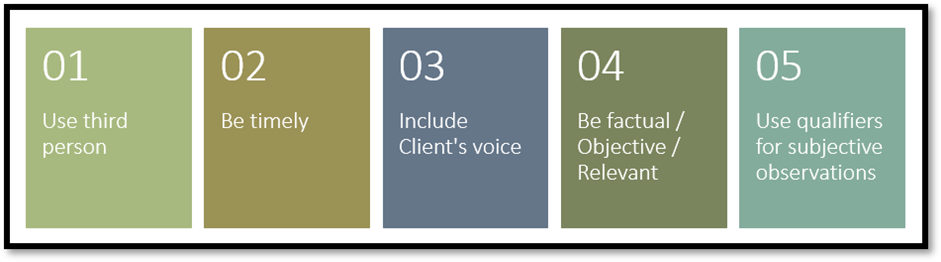
Please note that these are general recommendations for entering data in HMIS. For further guidance, speak with your supervisor regarding specific formats/methods for documenting case notes.
- Use third person: Instead of using the pronoun "I," use third-person titles such as “Case manager/ CM / OW conducted a home visit with client."
- Be timely: Case notes should be entered the same day or the day after the incident or meeting related to the case note occurred. If it is not possible to enter them on the same day, recording the information as soon as possible makes sure the information is more accurately entered.
- Include the participant's voice: What the participant states they want/need.
- Be Factual / Objective / Relevant: It is important that case notes include as many facts as possible.
--- Who was present?
--- What was observed or heard, and by whom?
--- Where did the interaction occur?
--- When did the interaction occur, and when is the next meeting scheduled?
--- Why was the interaction needed?
--- How was the participant assisted?
- Case notes should include:
- The intervention: What did you do to assist the participant?
- The participant’s response to the intervention. And the plan to move forward.
- Clearly state what occurred during the encounter:
- What was discussed.
- What goals were discussed.
- What action steps were put in place.
- What, if any, resources were provided, and/or whether or not resources were requested.
- Clearly describe the next steps:
- State whether or not the next meeting or a follow-up was scheduled.
- If so, provide the location and time of the next meeting.
- State the purpose and/or goal for the next encounter with the participant.
- Clearly identify roles and responsibilities for both the participant and case manager in preparation for the next encounter: “The case manager will…by this date. The participant will…by this date."
- Use qualifiers for subjective observations, such as "participant appeared intoxicated." Never state subject observations as facts unless there is documented proof.
Case notes should avoid diagnosing, jargon, or stereotypes and prejudices.
Case notes should avoid using emotionally charged words. For example: abnormal, dangerous, delusional, disturbed, hysterical, immature, impulsive, threatening, and uncooperative.
While it is important to be as descriptive as possible, protecting privacy is also important. The following topics include sensitive information that should be managed carefully. Use the guidance included below, discuss the note with the participant and ask if they would like the information shared with other agencies or set to private.
- Legal Information: A participant may share information with you about their legal status (i.e whether or not they are on probation, information about their criminal record, citizenship, etc). In an effort to protect the participant’s privacy regarding a legal matter, instead of disclosing specific information regarding the participant’s legal status, the following statement or a similar statement can be used: “The participant reported that he is currently involved in the legal system.”
- Substance Abuse: A participant may disclose that he or she utilizes particular substances. Instead of including in the case note what exact substances the client utilizes, the following statement or a similar statement can be used: “The participant disclosed that he or she utilizes substances that may interfere with his or her ability to be successful in this program.”
- Domestic Violence: A participant may disclose that he or she has been or is currently a victim of domestic violence. A case note should never include the name or address of a DV program or safe house in which a participant resides. If a participant reports involvement in domestic violence and shares the name or location of the DV program or safe house in which they are currently staying, the following statement or a similar statement can be used: “The participant reported that she was engaged in a physical incident over the weekend with her significant other. The client reported that she has been provided and connected to domestic violence resources”. DV case notes should always be marked private.
- Health: A participant may disclose specific information related to their health such as mental and/or physical diagnoses. Instead of including specifics on the participant’s diagnoses in the case note, the following or a similar statement can be used: “The participant reported that he or she is currently under or seeking care from a doctor for a medical condition.”
Contact Information
If you need help, or wish to offer suggestions or feedback, please contact the Cincinnati/Hamilton County HMIS Support team at HMISsupport@end-homelessness.org or by calling 513-263-2790 9:00 a.m. - 3:00 p.m. Monday through Friday (excluding holidays)
When contacting HMIS Support about a particular client, please do not send sensitive personally identifiable information (Sensitive PII) through email, such as full name, social security number, or any other information used to determine a person's identification. Instead, please send the Clarity Unique Identifier found on the client's Clarity Profile page. You can use the messaging system in Clarity if you need to send sensitive personally-identifying information.